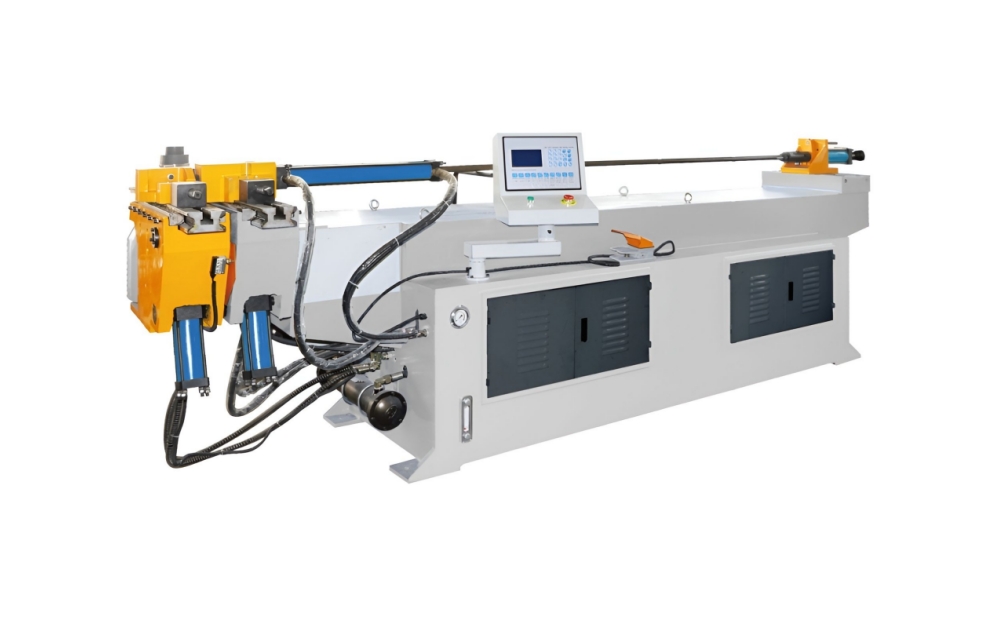
A cost-effective bending solution that combines hydraulic bending power with manual tasks, such as feeding and rotating the tube between bends. It is best suited for small to medium batch production or simple parts where full automation is not cost-justified.
The Wonsten semiautomatic NC pipe bending machine is a rugged, hydraulically driven tube bender designed for mid-volume production runs. Unlike fully automatic CNC machines, the NC (Numerical Control) series automates the most critical step—the bending angle (C-axis)—while the operator manually controls the tube feeding (Y-axis) and rotation (B-axis) using predetermined mechanical stops.
This configuration delivers high-torque, precise bending repeatability at a fraction of the capital investment of a full CNC system. It is the standard choice for fabrication shops processing 2D planar bends or simple 3D tubular components where fast setup times and machine durability are priorities.
Core Mechanical & Control Systems
Built on a heavy-duty welded steel frame, the NC series relies on industrial-grade hydraulics to generate the torque required for bending thick-walled carbon steel, stainless steel, and aluminum tubing.
Technical Specifications
(Note: The table below outlines our standard NC series parameters. We cover tube capacities ranging from Ø 27mm up to Ø 325mm for heavy pipeline applications.)
Specification | WST-38NC | WST-50NC | WST-75NC |
Max Tube Outer Diameter (OD) | Ø 38 x 2.0 mm | Ø 50 x 2.5 mm | Ø 75 x 3.0 mm |
Max Bending Radius (Standard) | 200 mm | 250 mm | 350 mm |
Max Bending Angle | 190° | 190° | 190° |
Bending Angle Precision | ± 0.15° | ± 0.15° | ± 0.15° |
Max Mandrel Length | 2000 mm | 2500 mm | 3000 mm |
Program Storage | 100 sets | 100 sets | 100 sets |
Motor Power | 4.0 kW | 5.5 kW | 7.5 kW |
Industry Applications
Because of its straightforward operation and heavy hydraulic power, the semiautomatic NC pipe bender is deployed extensively across:
Why Choose an NC Bender Over a CNC Bender?
If your parts consist primarily of single bends, or multiple bends on the same 2D plane (like a U-bolt or a simple rectangular frame), a CNC bender is an unnecessary expense. The NC machine provides the exact same ±0.15° bending angle precision as a CNC, but requires far less programming time and lower maintenance costs. Setup and tooling changeovers (bend die, clamp die, pressure die) can be completed by a single operator in under 20 minutes.
Frequently Asked Questions (FAQ)
What is the exact difference between an NC and CNC pipe bending machine?
An NC (Numerical Control) machine automates only 1 axis—the bending angle (C-axis). The operator must manually push and twist the tube between bends. A CNC (Computer Numerical Control) machine uses servo motors to automate all 3 axes: feeding, rotation, and bending.
Can the NC controller store programs with multiple different angles?
Yes. The PLC allows you to input a sequence of angles. For example, if a part requires a 45° bend, followed by a 90° bend, followed by a 30° bend, the operator programs this sequence. After each bend, the operator manually advances the tube, presses the foot pedal, and the machine automatically pulls the next angle in the sequence.
Can this machine process solid bar stock?
Yes. Equipped with the proper tooling, the hydraulic torque of the NC series can draw-bend solid round bars, square bars, and structural profiles, though the maximum capacity will be smaller than the hollow tube OD rating.
Get The Best Quote For Your Products